Combining cardio and strength training: the science has seriously qualified the fear of interference, and the answer depends on your goal.
The idea that a jog compromises your strength training gains dates back to 1980. More than forty years later, the picture is far more qualified. The answer depends on your goal, and the levers you can pull are identifiable.
Practical takeaways
Strength or hypertrophy first
Strength training first, cardio after 6 h of session spacing minimum, different days ideally
Endurance first
Cardio first, strength training after Heavy strength training twice a week improves your performance
Two more variables matter: the mode (cycling interferes less than running for mass) and session spacing, by far the most powerful lever. Here is why.
The interference effect: a dogma worth revisiting
The story starts in 1980 with Robert Hickson, a former powerlifter turned researcher. Frustrated at losing strength since he had started jogging with his supervisor, he designed the founding study of concurrent training: 10 weeks, three groups (strength only, endurance only, both). The result: strength gains were identical for 6-7 weeks in both groups doing strength training. Then, from week 8 on, the combined group plateaued, and dropped in weeks 9-10. VO2max improved by +20-25% in the endurance groups.
The concept of "interference" was born, and with it a generation of lifters convinced that a jog would compromise their gains.
Recent meta-analyses redraw that picture. The meta-analysis by Wilson et al. (2012) across 21 studies put a number on the effect: strength, measured as an effect size (an indicator of impact), drops from 1.76 (strength training only) to 1.44 in concurrent training. Hypertrophy drops from 1.23 to 0.85. And power collapses from 0.91 to 0.55. In concrete terms: mass and max strength take a small step back, but it is explosiveness (sprints, jumps) that suffers most.
The meta-analysis by Schumann et al. (2022), pooling 43 studies and more than 1,000 subjects, finds no significant interference on max strength or on hypertrophy. Only explosive strength stays affected, and even that effect disappears as soon as the sessions are separated by more than 3 hours.
Petré et al. (2021) add a useful qualification: in untrained subjects, interference is zero. In well-trained subjects, it becomes measurable again. The more advanced you are, the more you have to get the details right (order, spacing, volume).
Murach & Bagley (2016) go further: under good conditions (proper separation, enough calories, adequate protein), aerobic work can increase hypertrophy through better vascularization and satellite cell activation (the cells that repair and grow muscle).
Interference is real, but it can be controlled.
The mechanism of interference: AMPK against mTOR
Without diving into molecular biology (the review by Keith Baar does that in detail), here is what matters.
When you lift heavy, your muscle activates a signaling pathway called mTOR. It tells your cells: "Protein synthesis, we are building muscle." The protein synthesis that follows stays elevated for 24 to 48 hours after the session (Phillips et al. 1997).
When you do cardio, it is AMPK that activates (your muscle detects an energy shortage). And AMPK blocks mTOR. That is the biological basis of interference.
Coffey et al. (2009) demonstrated the acute mechanism: 10 maximal sprints done 15 minutes before a strength session completely abolish mTOR activation. Done after the strength training session, those same sprints do not affect mTOR activation. With moderate cardio, the effect stays minimal.
AMPK comes back down within a few hours. With 3 h of spacing or more, mTOR returns to normal activity. With 6 h or more, interference on strength is clearly reduced, and 24 h optimizes the adaptations further (Robineau et al. 2016). That is what session spacing is about.
One important qualification: resistance work activates a specific isoform called PGC-1α4 (Ruas et al. 2012), which inhibits myostatin and stimulates hypertrophy, whereas endurance activates PGC-1α1 (mitochondria). Endurance and muscle are therefore not genetically exclusive; they use different "versions" of the same gene.
The 4 levers, in order of importance
1. Session spacing
This is the most powerful lever. The study by Robineau et al. (2016), run at INSEP on 58 rugby players, compared 5 conditions over 7 weeks: strength training alone, then strength training + HIIT at 0 h, 6 h, 24 h and on alternate days.
The conclusion: 1RM gains (the max weight for one rep) on the bench and the squat are larger with 6 h of spacing or more. And VO2max improves more with 24 h of spacing.
More striking still: Sale et al. (1990) showed over 20 weeks that splitting the two qualities across different days almost doubles leg press strength gains (+25% vs +13% in the same session), for equivalent gains in hypertrophy and VO2max.
0 h
Back-to-back sessions Maximum interference
3 h
Effect partly blunted Suboptimal
6 h
Recommended compromise Minimum threshold
24 h or more
Different days Optimum
2. The order within the session
If you have to do everything in the same session, the order counts.
Sporer & Wenger (2003) measured that prior cardio reduces leg press volume up to 8 hours later, without affecting the bench. Interference is local, on the muscles worked in the cardio.
Over the long run, the meta-analysis by Eddens et al. (2018) settles it: strength training then cardio gives +6.9% of dynamic leg strength compared to the reverse. No significant difference on hypertrophy or VO2max.
Conversely, if the goal is maximal cardio power, doing the cardio first gives better specific gains.
The practical rule: strength training first for strength, cardio first for endurance.
3. Cardio volume and intensity
The thresholds Wilson identified are surprisingly convergent: beyond 3 cardio sessions a week or more than 20-30 min per session at a high heart rate, interference becomes measurable.
On HIIT vs moderate continuous work (Zone 2, a "conversational" pace at roughly 60-70% of your max HR), Fyfe et al. (2016) compared the two at equivalent load: HIIT blunts hypertrophy more than moderate cardio, probably through higher residual fatigue.
For someone oriented toward hypertrophy: Zone 2 on the bike > HIIT over the medium term. For an endurance athlete: short HIIT stays very effective for VO2max without penalizing strength more than continuous work does.
4. The mode (running vs cycling)
More qualified. Wilson 2012 found clear interference with running but not with cycling. Schumann 2022 no longer finds that difference in its larger corpus.
What stays biologically plausible: running loads the eccentric side more (ground impacts, so micro-damage), recruits a larger muscle mass, and stresses the slow fibers of the legs. Cycling, purely concentric, is less aggressive for recovery.
If you are prioritizing hypertrophy: cycling > rowing machine > incline walking > running.
Profile 1: gaining muscle (with a healthy heart)
Your goal: adding cardio without sabotaging your strength and hypertrophy progress.
A well-built sample week:
- Push strength training (Monday)
- Zone 2 cycling, 30-40 min, in the morning (Tuesday)
- Pull strength training (Wednesday)
- Rest or walking (Thursday)
- Leg strength training (Friday)
- Short bike HIIT, 12-15 min (Saturday, far from the leg session)
- Zone 2 walking or cycling, 45 min (Sunday)
The rules to follow:
- Aim for 150 min of moderate cardio a week (WHO recommendation), split across 2-3 Zone 2 sessions plus 1 short HIIT.
- Prefer cycling, incline walking or the rowing machine over long runs.
- Schedule cardio on strength training OFF days, or with 6 h of spacing or more from a hard session (legs above all).
- Same day: strength training first, cardio after.
- Avoid high-intensity HIIT right before or right after your leg session. That is the combination that interferes most.
Profile 2: running, cycling, or both, with strength training as support
For this profile, change perspective. For your endurance, strength training is a performance multiplier.
The reference review by Rønnestad & Mujika (2014) and the meta-analysis by Berryman et al. (2018) are unambiguous: heavy strength training improves running economy and cycling economy (your energy cost at a given pace), velocity at VO2max, and time to exhaustion, all without significant body mass gain.
Why? Because building your legs lowers the percentage of your max strength that you use at submaximal pace. You work more economically, you last longer. On the tendon side, heavy strength training increases musculotendinous stiffness and therefore the elastic return on every stride, so less energy is wasted.
The kind of strength training to do:
- Heavy, 4-10 reps max per set. Avoid long 15-rep sets that turn into disguised cardio.
- 2 sessions a week, 45 min, on easy days or 6 h or more after a hard endurance session.
- 4-5 compound exercises per session: squat or leg press (4×5), Romanian deadlift (3×6), lunges (3×8), standing calf raises (3×8), anti-rotation core work.
- Plyometrics in the specific phase: drop jumps, bounding. Paavolainen et al. (1999) showed +3% on a 5 km through improved running economy.
- For trail runners: eccentric exercises (slow-tempo Bulgarian split squat, step-down, pistol squat). Descents load the quadriceps eccentrically for a long time. Prepare it.
Block periodization (Issurin): 3-4 weeks of general hypertrophy (8-12 reps), then 2-3 weeks of heavy strength (4-6 reps) plus explosiveness, then 1-2 weeks of maintenance (1 session a week).
Your cardio fitness will stay intact. You will gain performance.
Nutrition and sleep: the fundamental pillars
You can optimize everything about session timing; if you are underfed or in sleep debt, it will get you nowhere.
Protein. The meta-analysis by Morton and Phillips (2018) identifies a useful threshold at 1.6 g/kg/day for hypertrophy, with an upper bound at 2.2 g/kg. In practice:
- Profile 1 (strength training): 1.6-2.2 g/kg/day
- Profile 2 (endurance plus strength training): 1.4-1.8 g/kg/day, and 1.6+ in an intensive strength training phase
Spread it across 3-4 servings of about 0.4 g/kg over the day. As for the 30-minute "anabolic window", Aragon & Schoenfeld (2013) showed that it is wide (4-6 h) and that total intake is what counts, not strict timing.
Carbohydrates. Critical in concurrent training, since you are taxing two energy systems. Aim for 5-10 g/kg/day, more during a heavy endurance week.
Below 30 kcal/kg of lean mass per day, you see hormonal disruption, bone loss, and a decline in running economy and explosive power (Mountjoy et al. 2018).
For tendons (useful in trail running): 15 g of gelatin plus 50 mg of vitamin C, 30-60 min before the session that loads the tendons (Baar 2017). This stimulates collagen synthesis.
Sleep. 7-9 h for an adult, 9 h ideally for a heavily loaded athlete. Degraded sleep cancels more gains than any badly optimized session order. HRV-guided training (adjusting hard sessions according to your morning heart rate variability, measured each morning with a heart rate strap and an HRV tracking app) is now better documented than fixed plans for advanced athletes (Vesterinen et al. 2016).
Practical recommendations
The interference effect is real, but it is dose-dependent. The levers to pull are, in order of importance:
- Session spacing. Do not place a demanding cardio session right before or right after a heavy strength training session. Aim for 6 h minimum, 24 h or alternate days ideally.
- The order within the session (if same session): strength training first for strength, cardio first for endurance.
- Weekly volume: 3 sessions of 20-30 min of cardio is the threshold beyond which interference becomes serious for strength-focused lifters.
- The mode: cycling > running for hypertrophy; it makes no difference for endurance (do the sport you actually practice).
And do not lose sight of what really drives the final result: enough calories, enough protein, enough sleep. Perfect session timing will never make up for a chronic deficit on those three pillars.
 The Overload weekly recap
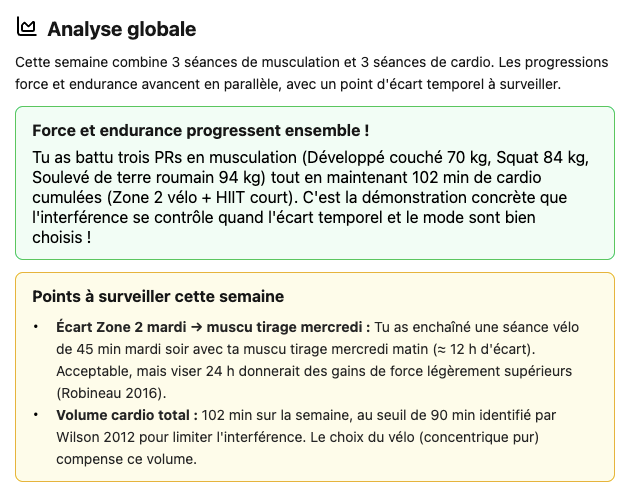
Every Sunday evening, Overload generates an AI recap covering your volume, your progressions, the muscle groups you worked and how your sessions were spread out. It lets you check, after the fact, whether you respected the levers described here: enough spacing between cardio and strength training, balance between the two disciplines, sustainable total load.
A drift such as 3 cardio sessions placed right before or right after your leg day shows up as soon as you read the recap, before it weighs on your progress.
Conclusion
For lifters, adding well-dosed cardio is an investment in your cardiac health, your recovery, and your muscle capillary density, which can favor hypertrophy over time through better nutrient delivery and satellite cell activation (Snijders et al. 2017).
For endurance athletes, heavy strength training twice a week is the best documented lever for gaining efficiency and performance, without gaining weight.
The worst-case scenario: stacking the two disciplines back-to-back and underfeeding the whole thing. Everything else is adjustable.
- Hickson (1980) — the founding interference study
- Wilson et al. (2012) — concurrent training meta-analysis
- Schumann et al. (2022) — updated meta-analysis across 43 studies
- Petré et al. (2021) — effect by training level
- Murach & Bagley (2016) — counter-arguments to interference
- Snijders et al. (2017) — capillary density conditions the hypertrophic response
- Baar (2014) — molecular biology of concurrent training
- Phillips et al. (1997) — muscle protein synthesis elevated up to 48 h after a resistance session
- Coffey et al. (2009) — acute mechanism of interference
- Ruas et al. (2012) — PGC-1α isoforms
- Robineau et al. (2016) — effect of session spacing (INSEP)
- Sale et al. (1990) — same session vs different days
- Eddens et al. (2018) — meta-analysis on intra-session order
- Sporer & Wenger (2003) — acute effect of cardio on volume
- Fyfe et al. (2016) — HIIT vs moderate continuous work
- Rønnestad & Mujika (2014) — strength training for endurance athletes
- Berryman et al. (2018) — meta-analysis on strength training plus endurance
- Paavolainen et al. (1999) — plyometrics and running economy
- Morton & Phillips (2018) — optimal protein intake
- Aragon & Schoenfeld (2013) — the anabolic window revisited
- Mountjoy et al. (2018) — RED-S IOC consensus
- Vesterinen et al. (2016) — HRV-guided training
This article presents the current scientific data. For a personalized program, consult a healthcare professional.